The way professional development used to look has changed in a huge way. When companies started to use hybrid work models, people had to change how they shared knowledge with others, going from lectures that weren’t interactive to experiences that combined technology with in-person activities. In this new era, learning is not an end goal anymore; it is something that is done all the time, even while working. This change has made sharing knowledge within organisations much more important than ever, which shows how vital the “accidental educator” is.
Central to this evolution is the concept of training the trainers. This strategy acts as a powerful workforce multiplier by empowering internal experts to scale their knowledge across the organisation. This shift is characterised by:
- Scalability: Transforming one expert into a source of knowledge for hundreds of employees.
- Cultural Alignment: Internal instructors understand the company’s unique nuances better than external consultants.
- Knowledge Retention: Gaining established expertise before it leaves the organisation.
However, this transition reveals a common corporate misbelief, the belief that being a Subject Matter Expert (SME) automatically translates to academic skill. The core challenge lies in the distinction between “knowing” and “showing.” An SME may possess deep technical expertise, but without a structured train-the-trainer framework, they often struggle with the “Curse of Knowledge”—the inability to remember what it was like to not understand a concept.
Effective teaching requires a specific set of competencies that SMEs often lack, such as:
- Instructional Design: Structuring information so it is digestible.
- Adult Learning Principles: Understanding that adults learn differently from students.
- Engagement Facilitation: Keeping a remote or hybrid audience focused.
Ultimately, the goal of modern corporate learning is to bridge the gap between expertise and education. By formalising how experts teach, organisations ensure that their most valuable intellectual property is effectively distributed to the entire workforce.
What is a Train the Trainer Course?
A common misconception in the corporate world is that a train the trainer course is simply a “refresher” on technical content. In reality, these programmes go well beyond the basics of subject matter. They focus on the science of how people learn instead of just what they are learning. An expert might know a software system or a legal compliance framework very well, but a professional trainer course teaches them how to pass on their knowledge as useful skills to other people.
1. The Key Pillars of Modern Instruction
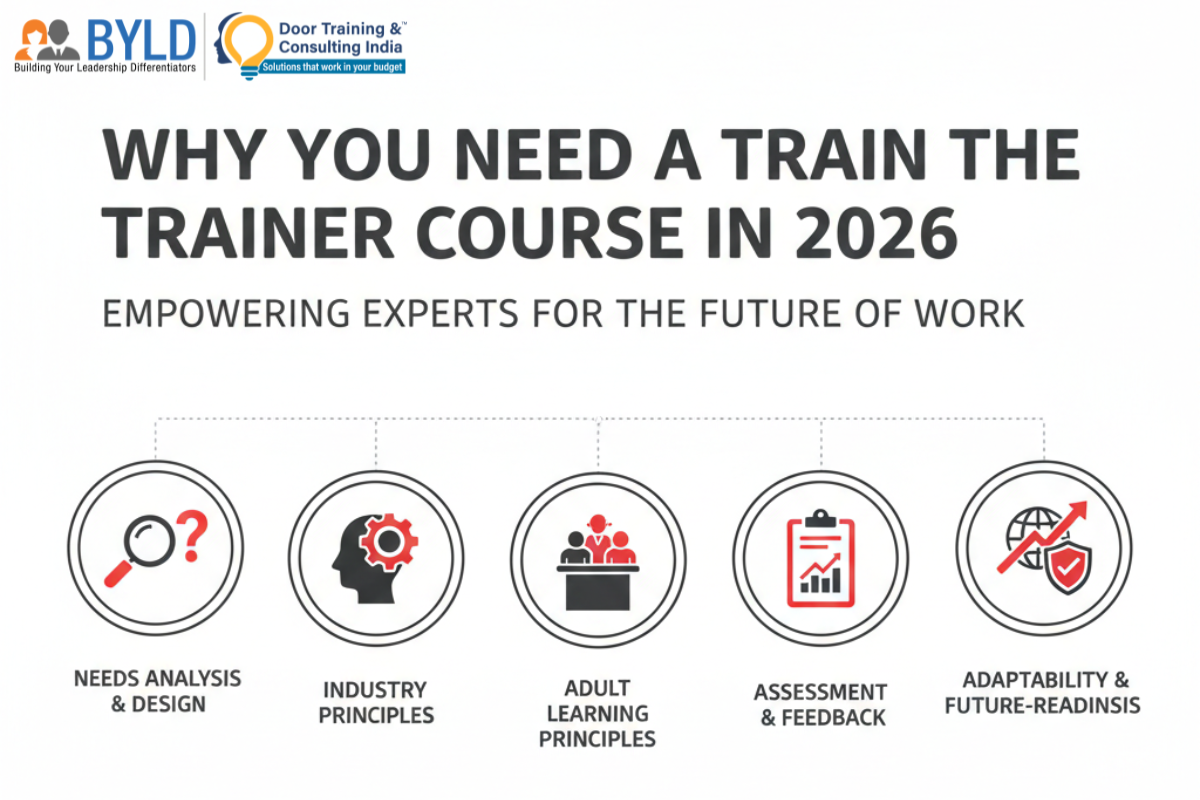
The three foundational pillars of effective training in 2025 that make sure knowledge is not just given, but also understood are:
- Adult Learning Principles (Andragogy): Unlike children, adult learners are typically self-directed, motivated by immediate relevance, and bring a wealth of prior experience to the table. A high-quality course teaches instructors to shift from a “teacher-centric” (pedagogy) to a “learner-centric” (andragogy) model, where the trainer acts as a facilitator rather than a lecturer.
- Curriculum & Instructional Design: This pillar involves the strategic “blueprint” of a session. Trainers learn to conduct a Needs Analysis to identify skill gaps, write SMART learning objectives, and structure content into digestible modules that prevent cognitive overload.
- Delivery & Engagement Techniques: Mastering the “how” of instruction includes everything from public speaking and body language to managing difficult group dynamics. In 2025, this also encompasses virtual facilitation, ensuring trainers can maintain engagement across remote and hybrid environments.
2. Who Should Enrol?
A train-the-trainer course is designed for a diverse range of professionals who find themselves in the role of an educator, even if “Trainer” isn’t in their official title:
- HR and L&D Professionals: To formalise their instructional background and lead large-scale organisational upskilling initiatives.
- Managers and Team Leaders: To better mentor direct reports and effectively onboard new hires within their specific departments.
- Independent Consultants: Who need to validate their skills and provide high-impact workshops to a variety of corporate clients.
- Subject Matter Experts (SMEs): Technical experts who are tasked with sharing their specialised knowledge across the broader company.
By participating in a structured train-the-trainer course, these professionals evolve into strategic facilitators who can drive measurable performance improvements within their organisations.
The Psychology of Adult Learning
To work in 2025, training the trainers needs to go beyond the old way of memorising things and look at the details of how adults think and learn. Adults who are learning don’t come as blank slates; they have a lot of work experience and certain expectations when they come to class. Knowing this psychology is what makes the difference between just giving a presentation and really changing someone’s mind with an experience.
1. Knowles’ 5 Principles of Andragogy
Malcolm Knowles revolutionised the field by defining “Andragogy”—the art and science of helping adults learn. A modern train-the-trainer course focuses on these five core pillars to ensure instructional success:
- Self-Concept: Adults need to be seen as independent and self-directed. They resist being “talked at” and prefer to have a say in their own learning journey.
- Experience: For an adult, experience is the richest resource for learning. Trainers must tap into the existing knowledge of the participants, allowing them to share insights and relate new information to what they already know.
- Readiness to Learn: Adults become ready to learn when they experience a need to know or do something to perform more effectively in their real-life roles.
- Orientation to Learning: Unlike children, who learn for future applications, adults are task-centred or problem-centred. They want to learn skills they can apply to their jobs immediately—specifically “just-in-time” learning.
- Motivation: While external motivators (raises or promotions) exist, the most potent drivers for adult learners are internal, such as increased job satisfaction, self-esteem, or the desire to solve a nagging workplace problem.
2. The Learning Cycle: From Theory to Action
Effective training, the trainers’ initiatives also utilise David Kolb’s Experiential Learning Cycle. This four-stage model ensures that information is not just heard, but practised and integrated:
- Concrete Experience: The learner actively experiences an activity (e.g., a role-play or a simulation of a new software tool).
- Reflective Observation: The learner reflects on the experience. What worked? What didn’t? Why did it happen that way?
- Abstract Conceptualisation: The trainer helps the learner form a theory or model based on their reflections, connecting the specific experience to broader principles.
- Active Experimentation: The learner applies their new theories to a different situation to test their validity.
By following this cycle, a train-the-trainer course ensures that the SME is not just dumping data, but guiding their colleagues through a process of discovery. This psychological approach transforms the classroom into a laboratory for growth, ensuring that knowledge “sticks” long after the session concludes.
Top 5 Benefits of Training the Trainers
These days, having a formal plan for training the trainers isn’t just nice to have for organisations; it’s a must for their strategy. In 2025, businesses that rely only on outside experts usually fall behind. By training a group of skilled facilitators within the organisation, businesses can gain a number of transformative benefits that affect the bottom line and company culture.
1. Internal Capability Building
The most immediate benefit is that you won’t need to rely on outside vendors as much. Outside experts can be helpful, but they usually don’t know enough about the company to fix certain internal issues. By focusing on training the trainers, a company ensures that its most valuable asset, established knowledge, stays within the building. This creates a self-sustaining ecosystem where expertise is continuously updated.
2. Consistency in Quality
Without a standardised approach, training becomes a “game of telephone” where information is diluted or messed up as it passes from one department to another. A structured program makes sure that every employee, regardless of their location or department, receives the same high standard of instruction. This consistency is vital for safety protocols, obedience, and maintaining a merged brand voice.
3. Professional Growth for the Facilitator
For the facilitator, taking a train-the-trainer course is a big boost to their career. For a Subject Matter Expert, being able to teach others is a “power skill” that makes them more visible and helps them become a leader. It turns them from a person with technical expertise into someone who can shape opinions and make an impact. People who took these classes often say
- Enhanced public speaking and presentation confidence.
- Improved emotional intelligence and conflict-resolution skills.
- A stronger professional network within the organisation.
4. Long-Term Cost-Efficiency
While there is an initial investment in the program, the long-term ROI of training the trainers is substantial. Organisations can scale their training programs to thousands of employees without paying per-head fees to external agencies. Furthermore, internal trainers can provide “just-in-time” learning, addressing skill gaps immediately as they arise, which prevents the costly productivity losses associated with waiting for a scheduled external seminar.
5. Adaptability in a Mixed World
Today’s training must be able to change at any time. A professional course teaches trainers how to quickly switch between virtual, in-person, and unsynchronised formats. No matter if it’s a global Zoom call or an in-person workshop, trained facilitators know how to keep people interested and make sure everyone learns what they need to know. This ability to change is a sign of a strong, future-ready workforce.
Read More – TTT Certification: Enhancing Your Career as a Corporate Trainer
Essential Skills Taught in a Train the Trainer Course
Mastering a subject is only half the battle; the other half is the ability to transfer that knowledge effectively. A train-the-trainer course focuses on specific behavioural and calculating skills that turn a nervous expert into a commanding facilitator. In 2025, these skills have become even more important as trainers must overcome the gap between physical and digital spaces.
1. Public Speaking & Body Language
Even the most seasoned experts can succumb to stage fright when tasked with leading a formal session. A train-the-trainer course provides actionable techniques to manage physiological stress responses and project confidence.
- The Power of Presence: Instructors learn how to use “open” body language to establish authority and rapport. This includes purposeful movement, meaningful eye contact, and the “power pose” to settle pre-session nerves.
- Vocal Variety: Trainers are taught to modulate their pitch, pace, and volume. A monotone delivery is a fast track to learner disengagement, especially in virtual environments where the “human element” is easily lost.
- Overcoming Stage Fright: By practising in a low-stakes environment, participants learn to reframe anxiety as excitement, ensuring that their nerves do not distract from the educational message.
2. Facilitation vs. Lecturing
The hallmark of a modern educator is the ability to facilitate rather than dictate. While lecturing is a one-way street, facilitation is a dialogue that invites the audience to participate in their own growth.
- Active Inquiry: A train-the-trainer course teaches SMEs how to ask “open-ended” questions that spark critical thinking rather than simple “yes/no” answers.
- The 80/20 Rule: High-impact training aims for the learners to be speaking or doing for 80% of the time, while the trainer facilitates the process for the remaining 20%.
- Creating Safe Spaces: Facilitators learn to foster a “psychologically safe” environment where employees feel comfortable making mistakes—a crucial component of the learning process.
3. Managing Difficult Participants
Every trainer will eventually encounter challenging personalities. Whether in person or via a chat box, knowing how to manage group dynamics is a vital skill taught in a train-the-trainer course.
- The “Know-it-All”: Trainers learn techniques to acknowledge the person’s expertise while gently pivoting back to the group or the curriculum to prevent one person from dominating the session.
- The Disengaged Learner: Strategies such as “gamification,” breakout rooms, or direct (but gentle) questioning help pull a distracted participant back into the fold.
- The Sceptic: Instead of becoming defensive, trained facilitators learn to validate concerns and use the sceptic’s perspective to explore the practical application of the material.
By the end of the program, participants possess the emotional intelligence and tactical prowess to lead any room with poise and purpose.
Curriculum Design and Instructional Material
The difference between a forgettable presentation and a transformative learning experience often lies in the structural design of the content. A high-quality train-the-trainer course moves beyond the “what” of teaching to focus on the “how” of architectural design, ensuring that instructional materials are grounded in proven educational systems rather than just visual appeal.
1. The ADDIE Model: A map for Success
The main focus of instructional design is the ADDIE model, a structured five-step process that provides a map for effective training development:
- Analysis: Identifying the actual performance gap. Is the problem a lack of skill or a lack of resources?
- Design: Outlining learning objectives, session flow, and assessment strategies.
- Development: Creating the actual assets—handouts, slide decks, and digital modules.
- Implementation: Delivering the training to the target audience.
- Evaluation: Using data and feedback to measure the program’s success and identify areas for improvement.
2. Moving Beyond "Death by PowerPoint"
Learners nowadays have shorter attention spans and higher expectations for PowerPoint. A train-the-trainer course teaches learners to make slides that do not distract the viewer from the main message. This involves shifting from text-heavy slides to high-impact images, infographics, and interactive elements. Trainers learn to apply the “Cognitive Load Theory,” ensuring that visuals reduce mental effort for the learner by highlighting essential information and removing “chart junk” or unnecessary bullet points.
3. Assessment Tools: impact of calculations
Training is an investment, and like any investment, its return must be calculated. Modern courses give trainers various assessment tools to find out if the learning actually “stuck”:
- Formative Assessments: Quick checks for understanding during the session (e.g., polls, “whiteboard” activities, or think-pair-share).
- Summative Assessments: Post-training tests or practical demonstrations to verify skill acquisition.
- Kirkpatrick’s Levels of Evaluation: Moving beyond “smile sheets” (how much they liked the class) to measuring behavioural changes on the job and final business results.
By mastering these design and assessment principles, graduates of a train-the-trainer course ensure their curriculum is not just informative, but results-driven and professionally polished.
What is the Train the Trainer Program in India?
In 2025, Asia will have solidified its position as a global hub for human capital development, with India leading the charge. The massive growth of the Indian EdTech and Skill Development sectors has created an insatiable demand for qualified instructors. As industries from IT to manufacturing undergo rapid digital transformation, the need for training the trainers has become a national priority to bridge the burgeoning “employability gap.”
1. Government Initiatives and Certifications
The Indian government has launched robust frameworks under the Skill India mission. Around this system is the National Skill Development Corporation (NSDC), which oversees standardised certification programs. These initiatives are designed to create a pool of “Certified Trainers” who can deliver high-quality vocational and technical education. So, what is the Train the Trainer program in India? Specifically, it is a competency-based framework—often aligned with the National Skills Qualifications Framework (NSQF)—that ensures instructors possess both domain expertise and the pedagogical “soft skills” required to teach effectively.
2. Aligning with Global Standards
The Indian approach to train-the-trainer programs is increasingly synchronised with international benchmarks. Leading Indian organisations now integrate global best practices—such as the ADDIE model and Andragogy—with local cultural nuances. This alignment ensures that a trainer certified in Mumbai or Bangalore possesses the same level of facilitation prowess as one in London or New York.
Key features of the Indian landscape include:
- Sector Skill Councils (SSCs): Tailoring instructor training to specific industries like Healthcare, Retail, or Telecom.
- Digital Integration: A heavy focus on “Phygital” delivery, preparing trainers for India’s massive remote workforce.
By formalising the process of training the trainers, India is not just upskilling its own people but is positioning itself as the “skill capital of the world,” providing a blueprint for how emerging economies can provide education through a structured train-the-trainer method.
Selecting the Right Certification
The competitive professional setup in 2025 means not all certifications are created equal. When investing in training the trainers, the first step is verifying authorisation. To make sure your qualification hold global weight, look for programs recognised by industry leaders such as the Society for Human Resource Management (SHRM) or the Association for Talent Development (ATD). These endorsements signify that the curriculum meets rigorous international standards for instructional excellence and ethical practice.
The next consideration is the delivery format. Your choice between an online train-the-trainer course and an immersive, in-person boot camp should depend on your specific career goals:
- Online Courses: These offer maximum flexibility and are ideal for those specialising in virtual facilitation. They allow you to master digital tools like Miro or Zoom within the environment where you will actually be teaching.
- Immersive Boot Camps: These provide high-intensity, face-to-face feedback. They are best for building physical presence, mastering body language, and networking with peers in real-time.
Ultimately, the right program should offer a blend of theoretical depth and practical “teach-back” sessions, ensuring you emerge not just with a certificate, but with the proven ability to inspire and educate.
Evaluating Success, Post-Training ROI
To justify the investment in a train-the-trainer course, organisations must look beyond completion rates and analyse the tangible return on investment (ROI). The gold standard for this evaluation is the Kirkpatrick Model, which breaks success down into four distinct levels:
- Level 1: Reaction: Did the participants find the training relevant and engaging? This is often measured through “smile sheets” and immediate feedback.
- Level 2: Learning: Did the trainers actually acquire the new skills? This is verified through “teach-back” sessions and assessments during the course.
- Level 3: Behaviour: Are the instructors applying their new pedagogical skills in the workplace? This tracks the shift from lecturing to active facilitation.
- Level 4: Results: What is the final business impact? This measures improvements in employee productivity, reduced turnover, and the cost savings achieved by eliminating external vendors.
By using this structured approach, companies can prove that training the trainers is not just an expense, but a strategic driver of organisational performance.
Conclusion
Training the trainers is no longer an optional expense; it is a strategic investment in organisational resilience. Mastering the art of instruction ensures your expertise has a lasting impact. Empower your workforce and lead the next generation of talent—enrol in a train-the-trainer course today to master the train-the-trainer methodology.
Frequently Asked Questions
A what is train the trainer program in india? is a certification aimed at turning experts into skilled facilitators. In 2025, this train the trainer model is vital for corporate growth, as train the trainer skills help scale internal knowledge. Every train the trainer course focuses on teaching train the trainer candidates how to engage audiences. By enrolling in a train the trainer course, you master train the trainer techniques.
A train the trainer course provides a structured train the trainer course curriculum that improves delivery. Completing a train the trainer course makes you a certified train the trainer expert. This train the trainer path allows a train the trainer graduate to lead a train the trainer workshop. Training the trainers ensures quality, as training the trainers creates consistency. Effective training the trainers sessions rely on this train the trainer foundation.
When training the trainers, the focus is on andragogy. This training the trainers process involves a train the trainer assessment. A train the trainer participant learns train the trainer strategies to handle difficult groups. Your train the trainer course will include a train the trainer course handbook and a train the trainer course certificate. Each train the trainer course is designed to polish train the trainer communication.
Far far away, behind the word mountains, far from the countries Vokalia and Consonantia, there live the blind Yes, because a train the trainer course offers a train the trainer course perspective on digital tools. Even for experts, training the trainers is helpful because training the trainers updates their skills. Through a train the trainer approach, a train the trainer leader can mentor others. Every train the trainer module in a train the trainer course adds value. The train the trainer industry recognizes that train the trainer success depends on a solid train the trainer course background.texts. Separated they live in Bookmarksgrove right at the coast
You can find a train the trainer course at top institutes. A train the trainer program usually involves train the trainer coaching and a final train the trainer project. Many who complete a train the trainer track become train the trainer consultants. With a train the trainer mindset, you can excel in any train the trainer role.