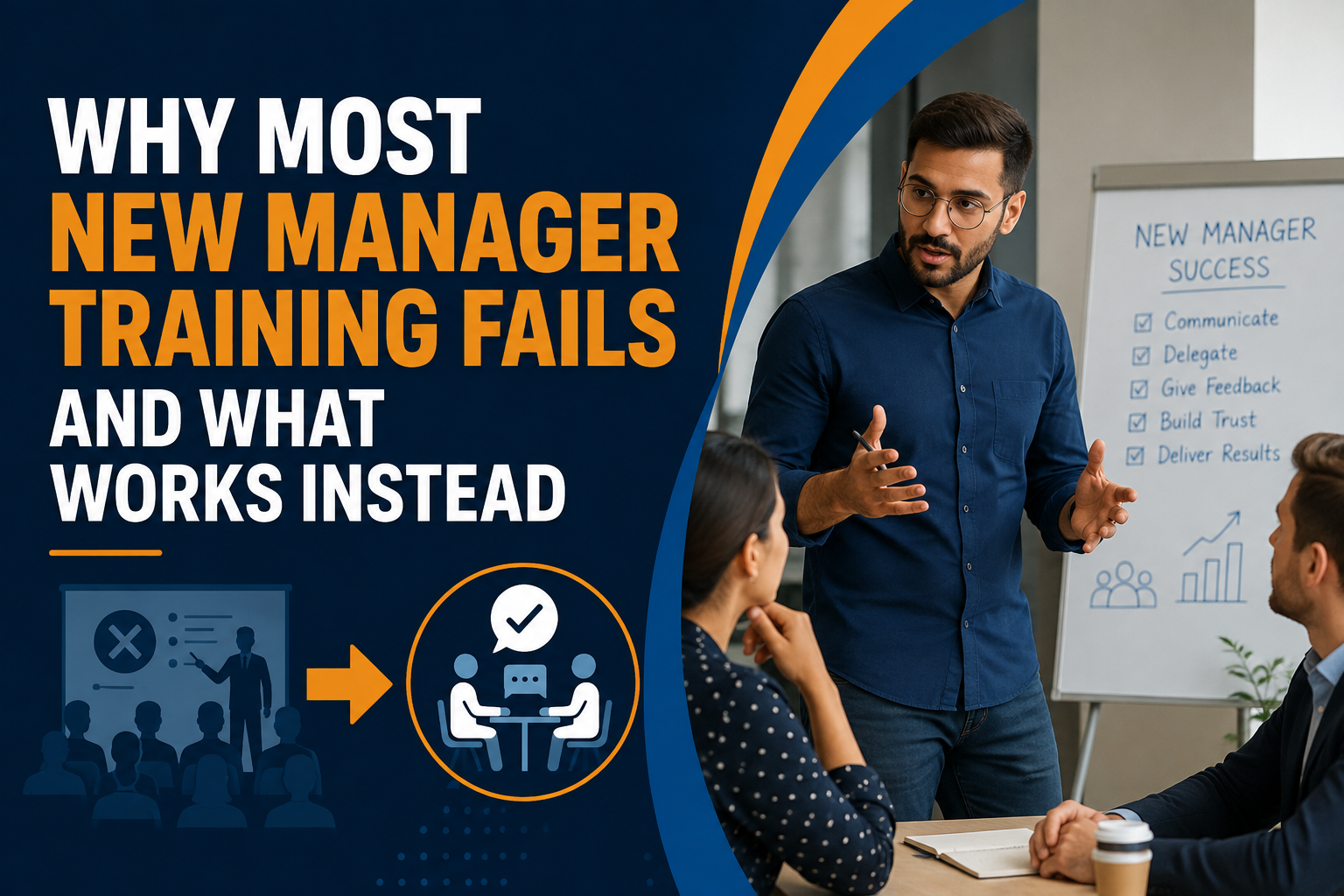
Every year, thousands of high-performers move into their first position as a people leader. They have excelled as individual contributors. But all of a sudden, they’re asked to conduct one-on-ones, handle conflicts, and make someone accountable for not meeting their goals without ever receiving an hour of preparation. So the organization throws another band-aid on the wound by holding a one-day workshop known as New Manager Training. Six months later, the same manager is dealing with the very same problems the workshop was supposed to solve.
This is not an occasional mistake. This is how things normally go. And this indicates a serious problem in the way management training programs are designed in most organizations.
The Accidental Manager Problem
Most managers don’t arrive in the role because someone assessed their leadership potential. They arrive because they were good at their previous job. Research from the Chartered Management Institute found that 82% of new managers take on their first leadership role without any formal training (source: CMI). That’s not a small gap; it’s the default condition of management in most organizations.
The competencies that were responsible for their promotion – precision, productivity, and knowledge – have little to do with the competencies they need now: providing feedback, delegation, mentoring, and conflict resolution. And this onboarding process, when it takes place, usually operates under the assumption that these two sets of competencies overlap. They don’t.
Why Traditional Programs Don't Stick
This is what usually happens in most companies: a day-or-two session, a PowerPoint presentation jam-packed with theoretical frameworks, some role-playing sessions, and then a certificate. This all feels so progressive but doesn’t change behavior.
It is simple enough to see why. Management training conducted classroom-style provides information, not skill. To hear a lecture about “providing constructive feedback” is very different from having the ability to do so when faced with a combative subordinate on Tuesday. Information is ephemeral, and much of what was learned in a single session will be lost in a few days, but the skill itself will take many repetitions to master.
Gallup’s research on workplace engagement found that managers account for at least 70% of the variance in team engagement scores (source: Gallup). In other words, the quality of everyday management conversations not strategy decks or resource allocation- is what actually moves the needle on how teams perform. A single workshop cannot realistically shift that.
Ready to Build the Right Leadership Pipeline?
Match the right type of leadership training to every level of your organization, from new managers to senior leaders, and turn learning into lasting behavior change.
Explore Leadership TrainingThe Conversations New Managers Avoid
What would be your expectations regarding the problems that a new manager might have? The list would include plenty of similarities, such as telling an employee that he/she is not performing well, managing conflicts among employees, and handling the issue of a subordinate who was once a colleague, etc.
This is exactly the type of conversation that you won’t be prepared for by generic management training. It’s one thing to have a single slide on the “feedback sandwich,” but it doesn’t prepare you to have a conversation with an employee who is responding defensively or emotionally to what you’re saying. When managers cannot have the conversation, they tend not to have the conversation at all or make it into something irrelevant.
Also Read: How Corporate Training Supports Organisational Growth in India
What Actually Works: Practice Over Passive Learning
Provided that information in itself is not the problem, more information cannot be the solution. What the data clearly shows is practice: structured, repetitive, low-risk, and safe practice of the actual dialogues that the manager will need to conduct later on.
This is where the shift from traditional workshops to genuinely effective management skills training for new managers needs to happen. Instead of a one-off session, effective programs build in:
- Preparation: a clear framework for the transition from doer to manager, delivered before the manager is thrown into the deep end.
- Practice: realistic rehearsal of the specific conversations the manager will face, tailored to the actual culture and context of the organization, not generic scenarios.
- Feedback: specific, behavioral observation of what was said and how it landed, not vague praise or generic tips.
When done properly, this type of development through practice is not only theoretical, but gives you muscle memory for those critical moments, such as your first difficult discussion, your first problem with performance, and your first pushback from your direct report.
Building the Right Development Path
The issue for organizations is not a choice between having one workshop or no workshops at all. It’s about designing a developmental process that is systematic and structured. The right development program would reflect the real first-year experience: role transition, delegation, receiving feedback, dealing with conflicts, and having performance talks in this particular sequence.
And this is precisely when the need for specialized training programs for emerging managers becomes obvious. Randomly organized sessions do not help develop skills that can be effectively applied to practice. A well-organized training program that looks at the first year of managerial experience as an entire process and not just one training session would be much more likely to develop managers capable of dealing with challenging tasks.
Companies that spend time developing true leaders in their new managers will experience results in areas that really count: less employee turnover within the manager’s group of the manager, quicker conflict resolution on minor issues so they do not become bigger problems, and greater and more accurate feedback up and down the line.
The measurement challenge is where most of what seem like perfectly good programs quietly crumble. Metrics for attendance and session-end satisfaction surveys are simple enough to collect, but don’t tell you much about how effective the manager is likely to be at having a tough conversation in three months. It’s the more important metrics – is feedback becoming clearer and more frequent for direct reports? Is turnover among employees on the manager’s team decreasing? – that are further downstream. Programs which focus on these types of outcomes, rather than completion rates, will have an easier time getting renewed support, since their value is readily apparent to the funders.
What Good Management Training Looks Like in Practice
A strong management training program for first-time managers typically includes:
- Context before content: New managers need to understand the identity shift from “doing the work” to “enabling others to do the work” before they’re handed a framework.
- Real scenarios, not generic ones: A one-size-fits-all case study about an underperforming employee doesn’t map cleanly onto every team’s dynamics or every industry’s culture.
- Spaced practice, not a single event: Skills like delegation, feedback, and conflict resolution need to be revisited and rehearsed multiple times, not covered once and assumed to stick.
- Behavioral feedback, not scores: Managers need to know specifically what they said, how it landed, and what to try differently, not just a completion certificate.
This is the difference between training that produces a certificate and a program that produces a manager who can walk into a difficult conversation with confidence.
Read More: Increase Your Emotional Intelligence With These Proven Strategies for the Workplace
The Bottom Line
The problem with most programs aimed at developing managers is simple – they fail because they attempt to solve a skills-based problem as if it were an informational one. Participating in a workshop and being able to conduct a difficult conversation in a challenging situation are entirely different activities. The successful organizations understand that they must change their approach from a one-time event to a structured process.
Be it a stand-alone session, a series of sessions, or even a more extensive process spanning many months, the core remains constant: capability is achieved through practice, not through one day’s PowerPoint presentation. Managers who get the first year of management correct lay the foundation for every future team they will ever manage.
Frequently Asked Questions
Most first-time manager training programs revolve around a one-off program like a workshop or an e-learning course, which provides knowledge but not the skill of managing conversations under pressure. This lack of skill due to the absence of continuous practice makes the program quickly forgettable and ineffective.
Effective manager training involves preparation for the role change, practical experience of the actual conversations a manager will be involved in, and behavioral feedback rather than just conducting one training session and handing out certificates.
In a typical training session, the management training program lasts only a few hours and then moves on. A realistic training program for new managers involves a spaced program spanning several weeks using scenario exercises that are specific to the organizational environment, giving the manager time to rehearse the process.
A leadership training program designed for new managers usually consists of one module that includes all necessary skills such as feedback and delegation. Leadership training programs that incorporate all necessary skills for new managers include many skill modules throughout their first year of work.
Without previous experience of handling such interactions, discussing underperformance or resolving conflicts becomes personally threatening. Newly appointed managers tend to postpone or water down these types of discussions in order to preserve the working relationship.
According to Gallup, managers account for at least 70% of the variance in employee engagement scores across teams (source). That means the quality of everyday management conversations has a far bigger impact on team performance than most strategic decisions.
Preferably, before the manager’s first tough talk, rather than months later after a poor handling of a performance problem. Upfront training for the first 60 to 90 days makes all the difference versus training that is added later on.
The completion rate and satisfaction scores tend to assess whether participants came, but whether they are capable of holding an actual conversation is not measured. Some factors that provide a better indicator of the effectiveness of training include attrition at the team level, early detection of any performance issues, and whether subordinates have received better and clearer feedback several months from the time of the training.